How to study a textbook chapter for an exam
Five steps, worked through on a real 96-page lesson. Four come from the research on how memory works; the first, a ten-minute map, is our suggestion for setting them up. All five work with a pen and paper. Where Hemle saves you time, we show what it made from the same lesson.
The chapter we worked on
Lesson 1, “Introduction to Epidemiology”, of CDC’s Principles of Epidemiology in Public Health Practice: 96 pages, public domain, and built like most textbook chapters, with objectives, sections, exercises and a quiz at the end.
Each step below is done on it twice: by hand, and in Hemle, where we uploaded it and kept what Hemle made, word for word.
Step 1 of 5
Map the chapter before you read it
Spend ten minutes before you read a word of the text. Read the objectives, the section headings, the summary and the questions at the end. They tell you what the chapter thinks matters.
Turn each objective into a question you’ll answer later. Note which sections lean on earlier ones, so you read those in order.
Why we suggest it
This step is our suggestion, not a research finding. Previewing comes from the SQ3R method, which a review finds has very little research behind it; it suggests dropping the survey and question steps and keeping read, recite, review, which is step 2. (Nebel, 2021)
We keep a short map anyway, for a practical reason: it gives steps 2 and 4 their questions.
By hand, on Lesson 1
Lesson 1 opens with ten objectives and a list of its sections (p. 1). Three of its objectives, turned into questions:
- “List the three components of the epidemiologic triad” becomes: what are the three parts of the epidemiologic triad?
- “Specify the elements of a case definition and state the effect of changing the value of any of the elements” becomes: what goes into a case definition, and what happens if I loosen one part?
- “Describe the different modes of transmission of communicable disease in a population” becomes: what are the ways a disease gets from one host to another?
It ends with a summary (p. 80), the exercises’ answers (pp. 81–84) and a 25-question self-assessment quiz with its answers (pp. 85–92). That quiz is step 4.
In Hemle
Hemle maps the lesson as it processes it: 25 concepts, each with its pages and the concepts it builds on. Its study path keeps a concept locked until you’ve answered well on the concepts it builds on directly. One chain from this lesson:
- Definition of EpidemiologyPage 2
- Epidemiologic TriadPage 52Page 53
- Natural History of Disease TimelinePage 59
- Infectious Disease CarriersPage 61
- The Chain of InfectionPage 62Page 64
- Herd ImmunityPage 68
Step 2 of 5
Read one section, then close the book and recall it
Read one section, not the whole chapter. Then close the book and write down, or say out loud, what it said: the main idea, the terms it defined, an example.
Open the book and check. What you missed or got wrong is what to read again, now, before the next section.
Why it works
College students who read a passage, recited what they remembered with it out of sight, then reviewed it, recalled more a week later than students who reread it or took notes. (McDaniel, Howard and Einstein, 2009)
Recalling a science text beat drawing a concept map of it with the text open, a week later, even on questions that asked students to reason from the text. (Karpicke and Blunt, 2011)
By hand, on Lesson 1
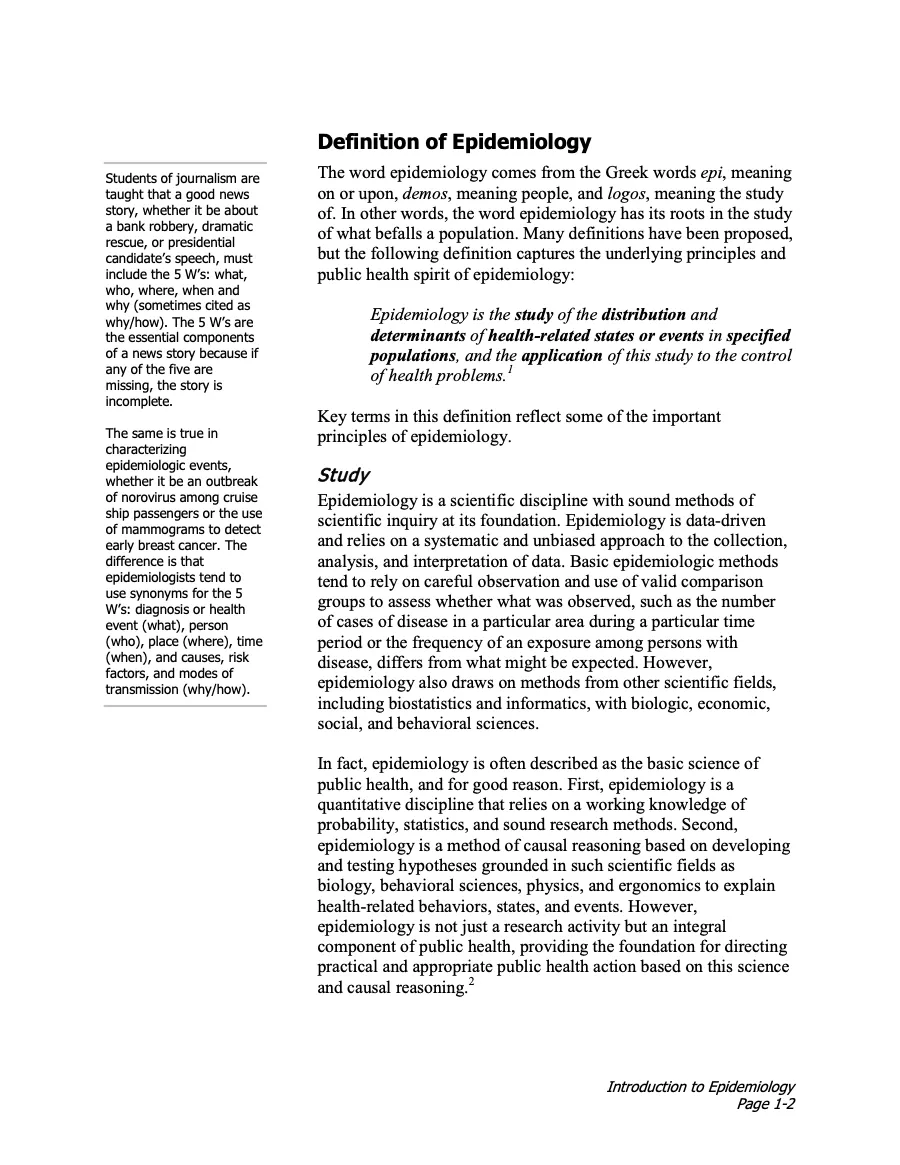
After “Definition of Epidemiology” (pp. 2–6), close the lesson and answer: what does epidemiology study, and what is it for? Then check your answer against its definition on page 2:
- “Epidemiology is the study of the distribution and determinants of health-related states or events in specified populations, and the application of this study to the control of health problems.”
In Hemle
Malet, Hemle’s tutor, asks for the same recall during a session, then checks the answer against the lesson. A real exchange on this section:
Check your understanding
In your own words, what does epidemiology study, and how can its findings help public health address a health problem?
The learner answered: How health problems spread across groups of people and what causes them, so health departments can act to control them.
You correctly connected population patterns and possible causes to public health action. For this next step, sort the questions by what they do: who, where, and when describe the distribution of a health event, while comparing affected and unaffected people to look for a shared exposure investigates its determinants. That comparison addresses why or how the health problem may have occurred.
Page 2Page 3Guided practice
A health team records which people became ill, where they live, and when symptoms began, then compares affected and unaffected people to investigate a shared exposure. Which observations describe distribution, and which part investigates determinants?
Step 3 of 5
Ask why, and what the difference is
For each idea, ask why it’s true and how it differs from the idea beside it. Answer in your own words, then check the page.
Chapters are full of pairs that sound alike, and exams like to set them side by side.
Why it works
Eighth graders who explained each sentence of a textbook unit to themselves understood it better than classmates who read it twice. They also spent longer on it, and there were only 24 of them. (Chi and colleagues, 1994)
A review of ten study techniques rates asking why and explaining to yourself as moderately useful: helpful, with less evidence than testing and spacing. (Dunlosky and colleagues, 2013)
By hand, on Lesson 1
Pairs in Lesson 1 worth explaining to yourself:
- An epidemic and a pandemic (pp. 72–73)
- A cohort study and a case-control study (pp. 47–49)
- Direct and indirect transmission (pp. 64–65)
- An incubation period and a latency period (pp. 59–60)
In Hemle
Explain it yourself first. Then, to check your answer, or when you can’t tell two ideas apart, ask Hemle’s Chat: it answers from the chapter and names the pages. The first pair, asked word for word:
Asked in Chat: What's the difference between an epidemic and a pandemic?
An epidemic is a rise in disease cases above what is normally expected in a particular population and area. A pandemic is an epidemic that has spread across several countries or continents, usually affecting many people (pp. 72–73).
| Term | What it describes |
|---|---|
| Epidemic | More cases than expected in a population in a particular area |
| Pandemic | An epidemic spread across several countries or continents, usually affecting a large number of people |
The key distinction is geographic spread: a pandemic is not a different kind of disease event, but an epidemic that has become much more widespread. The textbook’s exercise gives more than 20 million deaths from influenza worldwide in 1918–1919 as a situation to classify as a pandemic (p. 74).
These terms are useful because they help describe disease occurrence relative to what is normally expected and the area affected. They do not, by themselves, explain how the disease spreads or how severe it is. The evidence also does not give an exact numerical threshold for when an epidemic becomes a pandemic.
Does the part about epidemic make sense?
Step 4 of 5
Test yourself the way the exam will
Answer questions with the book closed: the chapter’s own exercises first, then the questions you wrote in step 1. Mark what you got wrong, and reread only those pages.
Mix questions from different sections, as the exam will, and write your answer before you look at the options.
Why it works
Students who read a passage in one five-minute study period (about three times), then took three recall tests on it, remembered 61% of it a week later. Students who spent four periods reading it (about 14 times) remembered 40%, though they felt surer they would. (Roediger and Karpicke, 2006)
A review of ten study techniques rates practice testing as one of the two most useful, for learners of different ages and abilities, on many kinds of test and in real classes. Mixing kinds of questions (interleaving) it rates moderately useful: promising, but only beginning to be studied. (Dunlosky and colleagues, 2013)
By hand, on Lesson 1
Lesson 1 gives you the questions:
- Eleven exercises along the way (1.1 to 1.11), with answers on pages 81–84
- A 25-question self-assessment quiz (pp. 85–89), and its answers, most with a reason (pp. 90–92)
The quiz says you may look back at the lesson. For practice, don’t: answer from memory first, then check.
In Hemle
Hemle writes a quiz on any concept and shows the sentence each answer rests on. Question 4 of 5 from its quiz on the epidemiologic triad:
Question 4 of 5
A factory experiences an outbreak of cutaneous anthrax among workers handling imported animal hides without protective clothing in poorly ventilated rooms. Under the epidemiologic triad model, how is the lack of protective antibodies or immune resistance among the workers classified?
Show answerHide answer
Answer B: A host factor
Pages 53 and 57 explain that host factors include intrinsic characteristics like immunologic status, age, and susceptibility. The lack of immune resistance or antibodies directly represents an intrinsic host factor. Ask yourself: Does immune resistance reside intrinsically within the human body or externally in the physical environment?
“Susceptibility and response to an agent are influenced by factors such as genetic composition, nutritional and immunologic status, anatomic structure, presence of disease or medications, and psychological makeup.”
Step 5 of 5
Come back to it over days, not hours
Spread your study of the chapter over separate days rather than one long sitting. Start each session with recall and questions, not rereading.
The further away the exam, the longer the gaps can be. If the exam is tomorrow, still test yourself rather than reread; spacing just needs days you no longer have.
Why it works
Adults learning facts in two sessions recalled more on the final test when the sessions were the best gap apart than when they were back to back: 10% more for a test a week away, 59 to 111% more for tests five weeks to a year away. The best gap grew with the time until the test: of the gaps tried, a day for a test a week away, three weeks for one ten weeks or a year away. (Cepeda and colleagues, 2008)
A review of ten study techniques rates spacing your study out as one of the two most useful, for learners of different ages, on many kinds of test and in real classes. (Dunlosky and colleagues, 2013)
In 271 comparisons, repetitions with a gap between beat back-to-back repetitions in all but 12. Most used word lists tested within minutes, so they show that spacing helps, not how far apart exam study should be. (Cepeda and colleagues, 2006)
By hand, on Lesson 1
With the exam a week away, Lesson 1 could go like this:
- Day 1: map the lesson; read its first six sections (pp. 2–45), recalling after each one.
- Day 2: read the other five sections (pp. 46–79) the same way; do the exercises.
- Day 4: take the self-assessment quiz from memory; reread the pages behind your misses.
- Day 6: answer your step 1 questions without the book; retry the questions you missed.
In Hemle
Hemle schedules each concept’s next review from how you did. After one lesson and one quiz on its first concept, it set the review two days out:
100%Oct 14
Stays above 90% until Oct 16. Review then and it holds until about Oct 26.
What to skip
These feel like studying. The research says they do little on their own.
Rereading
It’s what most students do, and a second read feels easy, which feels like knowing. A week later, students who reread remembered less than students who recalled. (Karpicke, Butler and Roediger, 2009) (Roediger and Karpicke, 2006)
Highlighting
Rated of low use in the review of ten techniques. Marking a line takes no recall: highlight to find things again, not as studying. (Dunlosky and colleagues, 2013)
One long night
Repetition with gaps beat back-to-back repetition in 259 of 271 comparisons, mostly word lists tested within minutes. Two sessions a day apart gave 10% more recall a week later than two back to back, and the best gap gave 59 to 111% more for tests five weeks to a year away. (Cepeda and colleagues, 2006) (Cepeda and colleagues, 2008)
Try it on your chapter
Drop in the chapter you’re studying. Hemle maps its concepts, then Malet takes you through them one at a time, with recall questions, quizzes and reviews that come back before you’d forget.
Common questions
What is the best way to study a textbook chapter?
Map it first, then read one section at a time and recall each one with the book closed. Explain the ideas that sound alike, test yourself with the chapter’s questions, and come back over several days. Recall and spaced practice have the strongest research behind them.
How do I study a chapter for an exam that’s tomorrow?
Skip rereading. Map the chapter, then answer its questions from memory and reread only the pages behind your misses. One session can’t give you the benefit of spacing, so start earlier for the next exam.
Should I highlight or take notes?
Highlighting is rated of low use for memory. Notes do more when you write them from memory, after you close the book: then they’re recall practice.
Are flashcards a good way to study a chapter?
Yes, if you answer each card before you turn it, and come back to the deck over several days. Cards you write from the chapter’s objectives and pairs of look-alike ideas are a good start.
Do I need Hemle for this?
No. Every step works with the book, a pen and the chapter’s own questions. Hemle saves time on each one: it maps the concepts, asks you to recall them, answers questions with the page, writes quizzes and schedules your reviews.
Is Hemle free?
Your first chapter is free, and you don’t need a card to start. Paid plans lift the limits when you want more.
Sources
Each study, with what it found. The worked example comes from Lesson 1 of Principles of Epidemiology in Public Health Practice, a public-domain course by the US Centers for Disease Control and Prevention. The replies, cards and quiz were made by Hemle’s AI; CDC doesn’t endorse Hemle.
- Nebel, C. (2021, March 4). SQ3R or read, recite, review. The Learning Scientists.A cognitive scientist’s review of the SQ3R method (survey, question, read, recite, review) finds very little research behind it as a whole, and suggests keeping its last three steps, of which reciting is retrieval practice.
- McDaniel, M. A., Howard, D. C., & Einstein, G. O. (2009). The read-recite-review study strategy: Effective and portable. Psychological Science, 20(4), 516–522.College students who read a passage, recited what they remembered with it out of sight, then reviewed it, recalled more of it straight away and a week later than students who reread it or took notes.
- Karpicke, J. D., & Blunt, J. R. (2011). Retrieval practice produces more learning than elaborative studying with concept mapping. Science, 331(6018), 772–775.College students who spent their study time recalling a science text did better a week later, on questions about its facts and on questions that asked them to reason from it, than students who spent the same time drawing a concept map with the text open.
- Chi, M. T. H., de Leeuw, N., Chiu, M.-H., & LaVancher, C. (1994). Eliciting self-explanations improves understanding. Cognitive Science, 18(3), 439–477.Eighth graders who explained each sentence of a textbook unit on the circulatory system to themselves understood it better than classmates who read it twice, though they also spent longer on it; the study was small, 24 students.
- Dunlosky, J., Rawson, K. A., Marsh, E. J., Nathan, M. J., & Willingham, D. T. (2013). Improving students’ learning with effective learning techniques: Promising directions from cognitive and educational psychology. Psychological Science in the Public Interest, 14(1), 4–58.A review of the research on ten study techniques rates practice testing and spaced practice as the most useful, asking why, explaining to yourself and mixing kinds of problems as moderately useful, and rereading, highlighting and summarising as of low use.
- Roediger, H. L., & Karpicke, J. D. (2006). Test-enhanced learning: Taking memory tests improves long-term retention. Psychological Science, 17(3), 249–255.College students who recalled a short passage from memory remembered more of it a week later than students who reread it (56% of it against 42%), although rereading did better on a test five minutes later and left students more confident.
- Cepeda, N. J., Pashler, H., Vul, E., Wixted, J. T., & Rohrer, D. (2006). Distributed practice in verbal recall tasks: A review and quantitative synthesis. Psychological Bulletin, 132(3), 354–380.In 271 comparisons from 254 studies, items repeated with a gap between were recalled better than items repeated back to back in all but 12; most used word lists, and 229 were tested within ten minutes, only 31 a day or more later.
- Cepeda, N. J., Vul, E., Rohrer, D., Wixted, J. T., & Pashler, H. (2008). Spacing effects in learning: A temporal ridgeline of optimal retention. Psychological Science, 19(11), 1095–1102.In an online study of 1,354 adults learning trivia facts, the best gap between two study sessions grew with the time until the test (of the gaps tried, one day for a test a week later, three weeks for a test ten weeks or a year later), and beat two sessions back to back by 10% for a test a week later and by 59 to 111% for tests five weeks to a year later.
- Karpicke, J. D., Butler, A. C., & Roediger, H. L. (2009). Metacognitive strategies in student learning: Do students practise retrieval when they study on their own? Memory, 17(4), 471–479.Of 177 students at one US university, 84% said they reread their notes or textbook and 55% named rereading as their main strategy; 11% said they tested themselves by recall.
More from Hemle
Spaced repetition
Each concept from your chapter, back just before you’d forget it.
AI quiz generator
Multiple-choice questions on your chapter, with an explanation for every answer.
Upload a textbook to AI
Ask your chapter anything; every answer names the pages it comes from.
PDF to flashcards
Flashcards from your chapter, each naming the page it came from.
The AI tutor
A real session on the same chapter: Hemle teaches it and cites the page as it goes.