Turn a PowerPoint into flashcards that cite the slide.
Drop in your lecture slides. Hemle writes flashcards and a practice quiz on what they teach, and every card and question names the slide it came from, so you can check it against your deck.
Four cards from a real lecture deck
Hemle made these from a 33-slide deck on the nervous system, from an open biology textbook. Turn a card over for its answer; the slide it cites sits beside it.
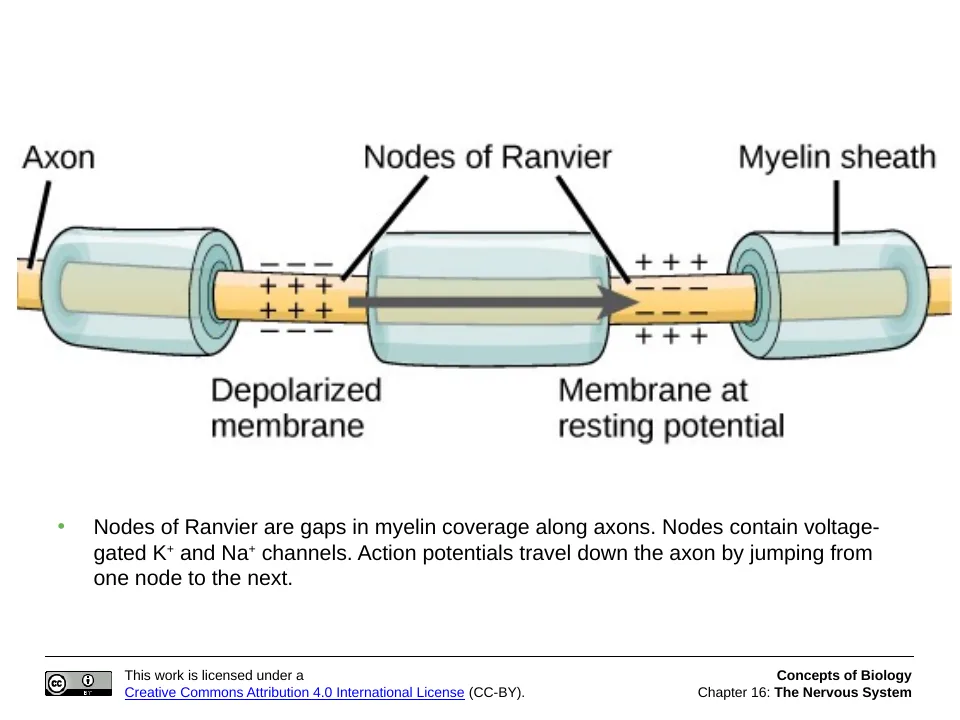
Saltatory Conduction
1 / 4From your lecturer’s slides
The cards come from the deck your course uses, in its terms, not from a public deck made for someone else’s course.
The slide, on every card
When a card surprises you, its slide number tells you exactly where to look in the deck.
Cards and a quiz from one upload
The same deck gives you flashcards, quizzes that explain every answer, and reviews that Hemle schedules for each concept.
Every card on three more of the deck’s concepts
Hemle wrote these 12 cards from the same deck on 28 October 2026. They are its cards on three of the 24 concepts it found, every card for each, word for word, with the slides they cite. Answer each one before you open it.
Specialized Neuronal Structures
3 cards from slide 4
What are two examples of specialized structures found in neurons that distinguish them from many other cell types?Show answerHide answer
Neurons possess specialized structures called dendrites and axons, which are adapted for receiving and transmitting signals.
True or False: Neurons lack common cellular organelles like a nucleus and mitochondria because they are highly specialized.Show answerHide answer
False. Neurons contain organelles common to many other cells, including a nucleus and mitochondria, in addition to their specialized structures.
Neurons contain common organelles such as a nucleus and __________, as well as specialized structures like dendrites and axons.Show answerHide answer
mitochondria
Electrochemical Basis of Resting Potential
4 cards from slide 11
What is the primary cause of the resting membrane potential in a cell?Show answerHide answer
The resting membrane potential results from different concentrations of Na⁺ and K⁺ ions inside and outside the cell, maintained by the active transport of ions via the Na⁺/K⁺ transporter.
True or False: The resting membrane potential is a static state where no ion movement occurs.Show answerHide answer
False. The resting potential is not static, as it is actively maintained by the Na⁺/K⁺ transporter which pumps K⁺ ions into the cell and Na⁺ ions out.
In the context of membrane potential, what occurs when a nerve impulse causes Na⁺ to enter the cell?Show answerHide answer
The entry of Na⁺ ions into the cell results in depolarization, which is a decrease in the charge difference across the membrane.
The resting membrane potential is a result of different concentrations of Na⁺ and K⁺ ions inside and outside the cell, maintained by the ________.Show answerHide answer
Na⁺/K⁺ transporter
Phases of the Action Potential
5 cards from slides 10–12
What are the five steps involved in the formation of an action potential?Show answerHide answer
(1) A stimulus causes the cell to depolarize toward the threshold potential. (2) If the threshold is reached, Na⁺ channels open and the membrane depolarizes. (3) At the peak, K⁺ channels open, K⁺ leaves the cell, and Na⁺ channels close. (4) The membrane becomes hyperpolarized and enters a refractory period. (5) K⁺ channels close and the Na⁺/K⁺ transporter restores the resting potential.
Why can a neuron not fire immediately after an action potential?Show answerHide answer
After an action potential, the membrane becomes hyperpolarized and enters a refractory period where it cannot fire in response to a new signal.
What happens to voltage-gated Na⁺ channels immediately after they are activated?Show answerHide answer
After activation, the Na⁺ channels become inactivated for a brief period and will no longer open in response to a signal.
During the formation of an action potential, what event occurs at the peak action potential regarding ion channels?Show answerHide answer
At the peak action potential, K⁺ channels open, allowing K⁺ to leave the cell, while Na⁺ channels close.
Hypothetical: If a cell is currently in a hyperpolarized state, what is its ability to fire an action potential?Show answerHide answer
The cell cannot fire an action potential because it is in a refractory period.
Made in Hemle. Every card on these three concepts is here, word for word, and the slides are the ones each card cites. From the Chapter 16: The Nervous System slides of Concepts of Biology – 1st Canadian Edition by Charles Molnar and Jane Gair (BCcampus), adapted from OpenStax’s Biology and used under a CC BY 4.0 licence. Credits for others’ figures are on their slides. We uploaded the deck unchanged; the cards and quiz were made by Hemle’s AI, and the authors don’t endorse Hemle.
A whole quiz from the same slides
Hemle wrote these five questions on one concept, the phases of the action potential, on 28 October 2026. Under each one: the answer, Hemle’s explanation, and the sentence on the slide it rests on. Hemle’s explanations call a slide a page: page 10 is slide 10. For question 3 the app didn’t find the sentence, so there is no quote.
Question 1 of 5
Which state of the voltage-gated Na⁺ channel is characterized by an inability to open in response to a new signal for a brief period following activation?
Show answerHide answer
Answer B: Inactivated
Page 10 describes the voltage-gated Na⁺ channel as inactivated for a brief period after activation, during which it will no longer open in response to a new signal. In contrast, at the resting potential, the channel is simply closed and ready to respond. Ask yourself: What physiological state prevents a channel from opening immediately after firing?
“After activation, they become inactivated for a brief period and will no longer open in response to a signal.”
Question 2 of 5
During the generation of an action potential, which event directly produces depolarization of the neuronal membrane?
Show answerHide answer
Answer A: Na⁺ entering the cell
Page 11 explains that a nerve impulse causes Na⁺ to enter the cell, which results in depolarization. Depolarization lessens the charge across the membrane. Ask yourself: Which ion moves into the cell to drive the membrane potential toward positive values?
“A nerve impulse causes Na+ to enter the cell, resulting in (b) depolarization.”
Question 3 of 5
What changes occur in ion channel activity precisely at the peak of the action potential (+30 mV)?
Show answerHide answer
Answer A: K⁺ channels open while Na⁺ channels close
Page 12 states that at step 3 (peak action potential), K⁺ channels open and K⁺ begins to leave the cell, while at the same time Na⁺ channels close. This initiates repolarization of the membrane. Ask yourself: What simultaneous channel events reverse the rising phase of the action potential?
Question 4 of 5
A researcher applies a supra-threshold depolarizing stimulus to an axon while its membrane is in step 4 (hyperpolarization). What will be the observed response of the axon?
Show answerHide answer
Answer C: The axon cannot fire an action potential because it is in a refractory period
Page 12 explains that during step 4, the hyperpolarized membrane is in a refractory period and cannot fire. Page 10 also notes that after activation, voltage-gated channels are inactivated and will not open in response to a signal. Ask yourself: Why does a neuron fail to generate a new impulse during the hyperpolarization phase?
“The hyperpolarized membrane is in a refractory period and cannot fire.”
Question 5 of 5
Following hyperpolarization, which mechanism restores the membrane to its baseline resting potential (step 5)?
Show answerHide answer
Answer C: K⁺ channels close and the Na⁺/K⁺ transporter restores the resting potential
Page 12 indicates that in step 5, the K⁺ channels close and the Na⁺/K⁺ transporter restores the resting potential. This transporter utilizes ATP to reset the ionic gradients. Ask yourself: What specific transporter re-establishes resting ionic balance once ion channels shut?
“(5) The K+ channels close and the Na+/K+ transporter restores the resting potential.”
Made in Hemle. The questions, answers, explanations and quoted sentences are word for word, from the quiz as submitted. From the Chapter 16: The Nervous System slides of Concepts of Biology – 1st Canadian Edition by Charles Molnar and Jane Gair (BCcampus), adapted from OpenStax’s Biology and used under a CC BY 4.0 licence. Credits for others’ figures are on their slides. We uploaded the deck unchanged; the cards and quiz were made by Hemle’s AI, and the authors don’t endorse Hemle.
How it works
Drop in your slides
A PowerPoint deck (.pptx or .ppt), up to 20 MB. Until you have an account, it waits in your browser.
Hemle finds the concepts
It reads every slide and maps the concepts the deck teaches: 24 from the 33 slides above.
Make cards, or take a quiz
Open a concept and choose “Make flashcards”, or “Quiz this concept” for five questions. Each card and question names its slide.
How Hemle compares
What each tool’s own pages say about turning PowerPoint slides into flashcards and a quiz, checked on 28 October 2026.
Where they do more
Quizgecko exports to Anki. SlideSpeak needs no account and exports to Anki, Quizlet, CSV or printable cards. Hemle doesn’t export.
Where Hemle does more
Neither tool’s pages say a card names its slide. Hemle’s do, and it keeps the deck in your library, with its quizzes and a review schedule for each concept.
| Hemle | Quizgecko | SlideSpeak | |
|---|---|---|---|
| Takes your PowerPoint | .pptx and .ppt, up to 20 MB and 100 slides free | .pptx and .ppt | .pptx |
| Names the slide on each card | Yes, on every card and question | Not stated | Not stated |
| A quiz from the same deck | Yes, with an explanation for every answer | Yes, editable practice questions | A separate tool: a printable PDF quiz with an answer key |
| Spaced repetition | Yes, per concept, set by your practice | Yes, SM-2 based | Not stated |
| Export | No | Anki | Anki, Quizlet, CSV or a printable PDF |
| Keeps your deck and cards | Yes, in your library | Not stated | No, it deletes both after delivery |
| Free plan | First deck, up to 100 slides | A limited Basic plan | Flashcards free with no account; the first 3 quizzes free |
Sources, each company’s own pages, checked on 28 October 2026: Quizgecko (flashcard generator, PowerPoint to quiz); SlideSpeak (flashcards from PowerPoint, quiz from PowerPoint). “Not stated” means those pages don’t say; the tool may still do it.
How to turn lecture slides into flashcards that stick
One lecture at a time
A single lecture’s slides give sharper cards than a whole term’s, and they’re what your next class builds on.
Answer before you flip
Saying the answer first, even a wrong one, is what makes it stick. Reading the back straight away mostly feels like learning.
Slides leave things out
Your lecturer says more than the slides show. When a card doesn’t match what you remember from class, look at the slide it names, then your notes.
Google Slides or Keynote?
Download it as PowerPoint (.pptx) first. In Google Slides that’s File, Download, Microsoft PowerPoint.
Common questions
Is Hemle free?
Your first deck or chapter is free, and you don’t need a card to start. Paid plans lift the limits when you want more.
How do I turn a PowerPoint into flashcards?
Upload the deck at the top of this page and create your account. Hemle reads the slides and maps the concepts they teach. Open a concept and choose “Make flashcards”.
Can Hemle make a quiz from my PowerPoint?
Yes. Open a concept and choose “Quiz this concept” for five multiple-choice questions, or build a custom quiz from the concepts you pick. Every answer comes with an explanation and the slide it comes from.
Do the cards say which slide they came from?
Yes. Every card and question names its slide. In the app, your deck opens as pages, one per slide, so slide 14 is page 14.
Which PowerPoint files can I use?
.pptx and older .ppt files, up to 20 MB and 100 slides on the free plan, or 50 MB and 1,000 slides on a paid plan. Using Google Slides or Keynote? Export the deck as PowerPoint (.pptx) first.
How many flashcards does Hemle make from a deck?
Up to five for a concept the first time you open its cards; the sets above have three to five. The 33-slide deck on this page gave 24 concepts.
What if a card is wrong?
Any AI can misread a slide, Hemle included. That’s why each card names its slide: check it there, trust your slides and your lecturer, and report the card from the card itself.
Is my file private?
Your file stays in your own library, and it isn’t used to train AI. You can delete it, or your whole account, at any time.
More from Hemle
Upload a textbook to AI
Ask your chapter anything; every answer names the pages it comes from.
PDF to flashcards
Flashcards from your chapter, each naming the page it came from.
AI quiz generator
Multiple-choice questions on your chapter, with an explanation for every answer.
Spaced repetition
Each concept from your chapter, back just before you’d forget it.
The AI tutor
A real session on the same chapter: Hemle teaches it and cites the page as it goes.