Upload your textbook. Get answers that cite the page.
Drop in the chapter you’re studying and ask it anything. Hemle answers from the chapter and names the pages each answer comes from, so you can read the passage yourself.
One question, asked of a real chapter
We asked Hemle’s Chat this about Lesson 1 of CDC’s Principles of Epidemiology, all 96 pages. Beside the answer is page 72, the first page it cites, with the passage the app marked.
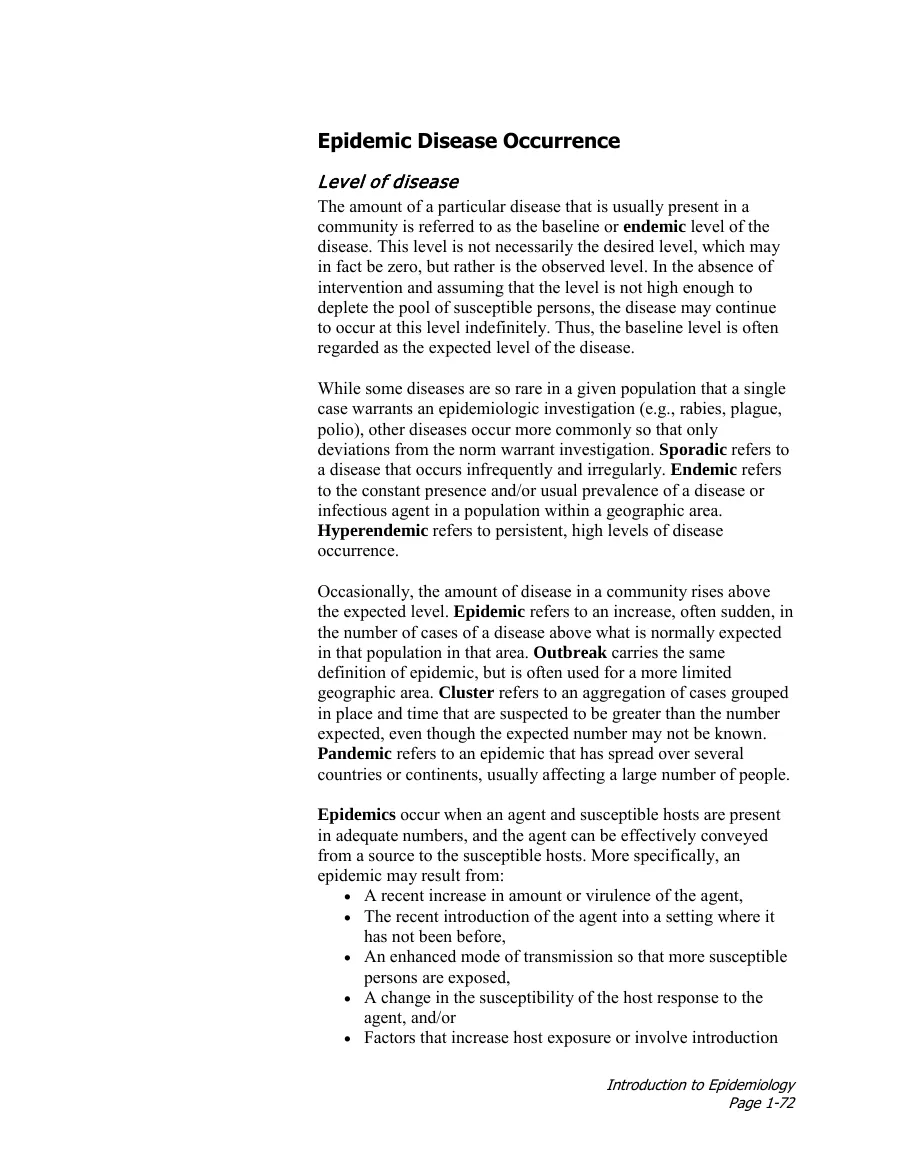
An epidemic is a rise in disease cases above what is normally expected in a particular population and area. A pandemic is an epidemic that has spread across several countries or continents, usually affecting many people (pp. 72–73).
| Term | What it describes |
|---|---|
| Epidemic | More cases than expected in a population in a particular area |
| Pandemic | An epidemic spread across several countries or continents, usually affecting a large number of people |
The key distinction is geographic spread: a pandemic is not a different kind of disease event, but an epidemic that has become much more widespread. The textbook’s exercise gives more than 20 million deaths from influenza worldwide in 1918–1919 as a situation to classify as a pandemic (p. 74).
These terms are useful because they help describe disease occurrence relative to what is normally expected and the area affected. They do not, by themselves, explain how the disease spreads or how severe it is. The evidence also does not give an exact numerical threshold for when an epidemic becomes a pandemic.
Does the part about epidemic make sense?
Answers are written by AI and can be wrong. Check the pages they cite.
Answers from your chapter
Hemle answers from the file you upload, so you get your book’s terms and examples.
The page, in the answer
Page numbers sit beside the point they support, so you know exactly where to read.
It says when your chapter doesn’t
Ask about something the chapter doesn’t cover and Hemle says so, as it did with the measles question below.
Three more questions, word for word
We asked Chat four questions about the same lesson on 27 October 2026: the one above and these three. Every answer is here in full, as Hemle wrote it, with the pages it cites in brackets.
What's the difference between a cohort study and a case-control study?
Show Hemle’s answerHide Hemle’s answer
The key difference is how participants are selected: a cohort study groups people by exposure status, while a case-control study groups people by whether they have the disease. Both are observational studies, meaning investigators observe exposure and disease status rather than assigning an exposure (pp. 47, 91).
Feature Cohort study Case-control study How participants are selected By whether they are exposed or unexposed By whether they have the disease or not What investigators compare Disease occurrence in exposed and unexposed groups The study starts with people who have the disease and uses a comparison group Main distinction Exposure determines the groups Disease status determines the groups In a cohort study, the investigator records each participant’s exposure status, then tracks or assesses whether participants develop the disease. The investigator compares disease rates in the exposed and unexposed groups; the unexposed group provides an estimate of the expected disease occurrence for comparison (p. 47). The cohort can be prospective, or retrospective: in a retrospective cohort study, both exposure and outcomes have already occurred, but investigators still compare disease rates between exposed and unexposed people (p. 48).
A case-control study instead begins by enrolling people who have the disease, then includes a comparison group based on disease status. The Self-Assessment Quiz highlights the distinction directly: cohort participants are enrolled or categorized based on exposure, not disease status (pp. 88, 91).
This difference is useful because it tells you what the study’s groups represent and what comparison the design supports. In a cohort study, the comparison is between disease rates in exposed and unexposed groups. The evidence provided here does not establish the specific measure or analysis used to compare groups in a case-control study.
The distinction is not simply that cohort studies take years while case-control studies are quick. The resource notes that some cohort studies run for years, while outbreak-related ones can be conducted in days; either study type can address a wide range of health problems (p. 91).
For example, investigators used a retrospective cohort study to investigate a cyclosporiasis outbreak among people at a residential facility in Pennsylvania. They compared disease occurrence among people with different exposures, and the investigation implicated consumption of snow peas as the source of infection (p. 48).
Does the part about cohort study make sense?
How is indirect transmission different from direct transmission?
Show Hemle’s answerHide Hemle’s answer
Direct transmission carries an infectious agent straight from a reservoir to a susceptible host through direct contact or short-range droplet spread. Indirect transmission carries it by an intermediary: suspended particles in the air, an inanimate vehicle, or a living vector. The key difference is whether transmission happens directly between the source and host or uses something in between (pp. 64-65).
Mode How the agent reaches the host Examples from the resource Direct contact The host comes into direct contact with the infectious agent. Skin-to-skin contact, kissing, sexual intercourse, or contact with contaminated soil or vegetation (p. 64). Droplet spread A short-range spray from coughing, sneezing, or talking reaches the host before the droplets fall. Pertussis and meningococcal infection are listed as examples (p. 64). Indirect transmission The agent is carried by suspended air particles, an inanimate vehicle, or a living intermediary. Airborne particles, food, water, fomites such as bedding or scalpels, and vectors such as mosquitoes (pp. 65, 91-92). To follow the difference step by step, start with the reservoir, the source from which an infectious agent can be transmitted. The agent must then reach a susceptible host. In direct transmission, the route is direct contact or short-range droplet spread. In indirect transmission, the agent reaches the host through a carrier or intermediary: airborne particles, an inanimate object or substance, or a vector (pp. 64-65).
The distinction between droplets and airborne particles depends on how they travel. Droplet spread counts as direct transmission because the spray travels only a few feet and reaches someone before the droplets fall to the ground. Airborne transmission counts as indirect because infectious particles can remain suspended in the air for long periods and travel farther. These airborne particles may be dust or dried droplet nuclei smaller than 5 microns (pp. 64-65).
The resource gives a concrete airborne example: children developed measles after entering a physician’s office where a child with measles had already been. The example illustrates indirect transmission because the virus remained suspended in the air after the infected child had left. The later visitors did not need to have direct contact with that child (p. 65).
In vehicleborne transmission, an inanimate carrier transports the agent. The resource names food, water, blood and other biologic products, and fomites, meaning inanimate objects such as handkerchiefs, bedding, or surgical scalpels. Its quiz also treats foodborne transmission and objects such as doorknobs or toilet seats as examples of indirect transmission (pp. 65, 88, 91-92).
In vectorborne transmission, a living intermediary carries the agent. Mosquitoes are given as an example of vectors. The exercise on dengue describes transmission to humans by a mosquito vector, with the mosquito bite involved in the route of transmission (pp. 84, 91-92). The resource identifies mechanical and biologic vectorborne transmission as categories, but the cited material here does not explain how those two types differ.
The Self-Assessment Quiz checks the distinction directly. It lists mosquito-borne, foodborne, and transmission through doorknobs or toilet seats as indirect, while its answer key excludes droplet spread. The answer key explains that droplet spread is generally considered short-distance direct transmission (pp. 88, 91-92). So, when deciding which mode applies, ask whether the agent passes by direct contact or a short-range spray, or whether it is carried by air particles, an inanimate vehicle, or a living vector.
Does the part about transmission make sense?
What's the basic reproduction number (R0) of measles?
Show Hemle’s answerHide Hemle’s answer
The provided evidence does not state a numerical R₀ for measles. It does show how measles can spread: infectious particles can remain suspended in the air, and children have contracted measles after entering a physician’s office once a child with measles had already left (p. 65). The source also notes that measles outbreaks can show successive peaks about 11 days apart, consistent with the disease’s incubation period (p. 76). These details describe transmission, but they do not establish a basic reproduction number.
Does the part about measles make sense?
Made in Hemle. The questions and answers are word for word, from the chats as stored. From Lesson 1 of Principles of Epidemiology in Public Health Practice, a public-domain course by the US Centers for Disease Control and Prevention. The replies, cards and quiz were made by Hemle’s AI; CDC doesn’t endorse Hemle.
How it works
Drop in your chapter
A PDF, Word file or PowerPoint deck, up to 20 MB. Until you have an account, it waits in your browser.
Ask your question
Type it in Chat, beside your chapter, the way you’d ask a classmate who has read it.
Check the page
Each answer names the pages it draws on. Tap any of them and your chapter opens there, with the passage highlighted.
How it differs from uploading a chapter to a chatbot
ChatGPT and Gemini Notebook (until July 2026, NotebookLM) read uploaded files too, and answer questions about them. Here is what their own pages say, checked on 27 October 2026.
The page, not just a quote
Gemini Notebook’s citations open the quote in your file. ChatGPT quotes passages when you ask, and for files connected from Google Drive, Box, Dropbox or SharePoint, on paid plans on the web, its citations lead back to the source. Neither says it names the page. Hemle puts the page number in the answer.
Reviews on a schedule
The chapter stays in your library with its chats, flashcards and quizzes, and Hemle brings each concept back just before you’d forget it. Neither tool’s pages say it schedules reviews.
It can be wrong too
Any AI can misread a passage, Hemle included. That’s why every answer shows its pages: when one disagrees with your book, trust the book.
| Hemle | ChatGPT | Gemini Notebook | |
|---|---|---|---|
| Reads your chapter | PDF, Word, PowerPoint | PDF, Word, PowerPoint and more | PDF, Word, PowerPoint, ePub and more |
| Shows where an answer comes from | Yes, inside the answer | Quotes passages when you ask; citations back to files from Drive, Box, Dropbox or SharePoint, on paid plans, on the web | Yes, citations that open the quote |
| Names the page | Yes; each page it names opens with a tap | Not stated | Not stated |
| Keeps the chapter for next time | Yes, in your library | Yes, in a project | Yes, in a notebook |
| Flashcards and quizzes from it | Yes | Yes | Yes |
| Schedules your reviews | Yes, per concept, set by your practice | Not stated | Not stated |
| Free plan | First chapter, up to 100 pages | Yes; 3 file uploads a day | Yes, with a Google account |
Sources, each company’s own pages, checked on 27 October 2026: ChatGPT (file uploads, copy of 22 October, release notes, copy of 26 October, projects, copy of 23 October); Gemini Notebook (the rename, sources, chat and citations, flashcards and quizzes, plans). “Not stated” means those pages don’t say; the tool may still do it.
Hemle and Gemini Notebook, compared in fullHow to ask your textbook good questions
Upload the chapter you’re on
One chapter keeps answers on what your course covers this week. Add the next one when you get there.
Ask for a difference
“What’s the difference between X and Y?” makes the answer set two ideas side by side, which is where exam questions hide.
Ask in your own words
You don’t need the book’s terms. If you only half remember an idea, describe it and ask what it’s called.
Read the page it cites
An answer is a summary. When it matters, or when it surprises you, open the page and read the passage.
Common questions
Is Hemle free?
Your first chapter is free, and you don’t need a card to start. Paid plans lift the limits when you want more.
Can I upload a textbook to AI?
Yes. Upload a chapter as a PDF, Word or PowerPoint file up to 20 MB, then ask about it in Chat. For a whole textbook, upload the chapter you’re studying: your free chapter can be up to 100 pages.
Does Hemle cite the page number?
Yes. Chat’s answers name the pages they draw on, like (p. 65), (pp. 72–73) or (pp. 47, 91). Tap any of them and your chapter opens at that page, with the passage highlighted.
What if the answer isn’t in my chapter?
Hemle answers from your chapter, and when the chapter doesn’t cover what you asked, it says so. Asked for the basic reproduction number of measles, it said the lesson doesn’t give one.
How is this different from uploading a textbook to ChatGPT?
ChatGPT can read an uploaded chapter, answer questions about it and quote passages when you ask, and for files connected from Google Drive, Box, Dropbox or SharePoint, on paid plans on the web, its citations lead back to the source. OpenAI’s help pages don’t say that ChatGPT names the page or schedules reviews. Hemle’s answers name the page each point comes from, and Hemle brings each concept back for review just before you’d forget it.
Is the answer always right?
No. Answers are written by AI and can be wrong. That’s why they name their pages: read the passage, and trust your book when the two disagree.
Can I also make flashcards and quizzes from it?
Yes. The same chapter gives you flashcards, quizzes and Malet, a tutor that teaches it one concept at a time.
Is my file private?
Your file stays in your own library, and it isn’t used to train AI. You can delete it, or your whole account, at any time.
More from Hemle
PDF to flashcards
Flashcards from your chapter, each naming the page it came from.
PowerPoint to flashcards
Flashcards and a quiz from your lecture slides, each naming its slide.
AI quiz generator
Multiple-choice questions on your chapter, with an explanation for every answer.
Spaced repetition
Each concept from your chapter, back just before you’d forget it.
The AI tutor
A real session on the same chapter: Hemle teaches it and cites the page as it goes.