Turn a PDF into flashcards that cite the page.
Drop in a chapter and Hemle writes flashcards for the concepts it teaches, each one naming the page it came from, so you can check any card against your book.
Five cards from a real chapter
Hemle made these from Lesson 1 of CDC’s Principles of Epidemiology. Turn a card over for its answer; the page it cites sits beside it.
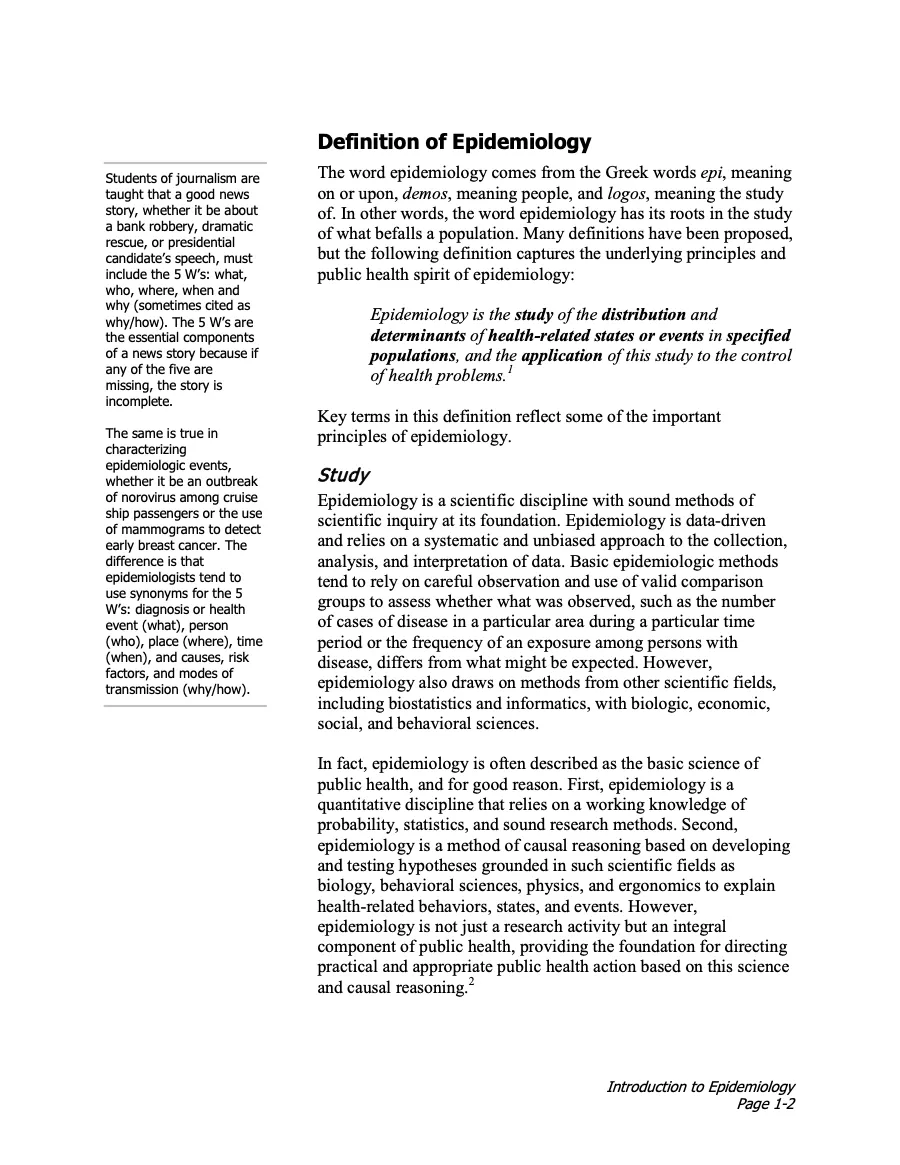
Definition of Epidemiology
1 / 5From your chapter, not a public deck
The cards come from the file you drop in, not from someone else’s notes on a different book.
It catches the common mistakes
Beside plain definitions, Hemle writes cards that test the mix-ups students make, like thinking epidemiology is only a research discipline.
Every card names its page
When a card surprises you, its page number tells you exactly where to look.
Every card from three more concepts
Hemle wrote these 13 cards from the same lesson on 27 October 2026. They’re all here, word for word, with the pages they cite. Answer each one before you open it.
John Snow's Spot Map
4 cards from page 8
What is a spot map in the context of epidemiological investigation?Show answerHide answer
A spot map is a map that shows the geographic distribution of cases of a disease within an area. It is used to visualize where affected individuals live or work to help identify potential sources of infection.
How did John Snow use a spot map to investigate the 1854 cholera outbreak?Show answerHide answer
Snow marked the residences of cholera victims on a map and then added the locations of water pumps. By observing that cases clustered around the Broad Street pump, he was able to hypothesize that it was the primary source of infection.
True or False: A spot map is used solely to document the total number of cases in a specific geographic region.Show answerHide answer
False. While a spot map does show the geographic distribution of cases, its primary purpose in an investigation is to visualize the distribution relative to potential sources to identify common points of exposure.
A map that displays the geographic distribution of disease cases is known as a __________.Show answerHide answer
spot map
Sensitivity vs. Specificity
4 cards from pages 26–27
What is the primary trade-off between a sensitive case definition and a specific (strict) case definition?Show answerHide answer
A sensitive definition is broad and aims to capture most or all true cases, but it risks including other illnesses (false positives). A specific definition is strict and aims to ensure that everyone included truly has the disease, but it risks underestimating the total number of cases by missing some true cases.
Why might an investigator prefer a strict case definition during a disease outbreak investigation?Show answerHide answer
An investigator prefers a strict definition when they need to be certain that every person included in the study truly has the disease, which helps them more accurately identify the source of the infection.
True or False: A sensitive case definition is always superior because it captures all true cases.Show answerHide answer
False. While a sensitive definition is useful for identifying every possible case of a severe disease, its disadvantage is that it is broad and may include individuals who have other illnesses, leading to false positives.
A case definition that is broad or 'loose' in the hope of capturing most or all true cases is known as a __________ case definition.Show answerHide answer
sensitive
The Chain of Infection
5 cards from pages 62–68
What is the sequence of events known as the chain of infection?Show answerHide answer
The chain of infection is the sequence where an infectious agent leaves its reservoir or host through a portal of exit, is conveyed by a mode of transmission, and enters a susceptible host through an appropriate portal of entry.
True or False: To stop the spread of an infectious disease, one must eliminate the infectious agent entirely.Show answerHide answer
False. The resource states that interrupting any single link in the chain of infection, such as the reservoir, portal of exit, mode of transmission, portal of entry, or host susceptibility, can effectively stop the spread of the disease.
Hypothetical: If a public health initiative focuses on promoting handwashing to prevent fecal-oral transmission, which link in the chain of infection is being targeted?Show answerHide answer
This intervention targets the mode of transmission by interrupting the vehicleborne transfer of the infectious agent.
The chain of infection sequence begins when an agent leaves its reservoir or host through a portal of ________.Show answerHide answer
exit
How does the concept of herd immunity attempt to interrupt the chain of infection?Show answerHide answer
Herd immunity attempts to prevent a pathogen from encountering a susceptible host by ensuring a high enough proportion of the population is resistant, making it unlikely for the pathogen to find the few remaining susceptible individuals.
Made in Hemle. Every card is word for word, none is left out, and the pages are the ones each card cites. From Lesson 1 of Principles of Epidemiology in Public Health Practice, a public-domain course by the US Centers for Disease Control and Prevention. The replies, cards and quiz were made by Hemle’s AI; CDC doesn’t endorse Hemle.
How it works
Drop in your chapter
A PDF, Word file or PowerPoint deck, up to 20 MB. Until you have an account, it waits in your browser.
Hemle finds the concepts
It reads the chapter, maps what it teaches, and writes cards for each concept, including cards that catch a common mistake.
Study with the page beside you
Every card names its page. Go through a concept’s cards whenever you like, and practise it when you want Hemle to schedule a review.
How Hemle compares
What each tool’s own pages say about turning a file into flashcards, checked on 27 October 2026.
| Hemle | Knowt | Quizgecko | RemNote | Anki | |
|---|---|---|---|---|---|
| Makes cards from your file | PDF, Word, PowerPoint | PDF, PowerPoint, images, video, audio | PDF, slides, notes | PDF, PowerPoint, Word | You write them, or use a shared deck |
| Names the page on each card | Yes, every card | Not stated | Not stated | Not stated | Not stated |
| Spaced repetition | Yes, per concept, set by your practice | Yes | Yes, SM-2 based | Yes, SM-2 or FSRS | Yes, FSRS or SM-2 |
| Free plan | First chapter, up to 100 pages | Yes; AI summaries of files, 1 a month | A limited free plan | Yes, with limited AI cards | Free on computers and Android; paid on iPhone |
Sources, each company’s own pages, checked on 27 October 2026: Knowt (AI flashcard maker, free plan); Quizgecko (PDF to flashcards, PDF to quiz); RemNote (Learn any PDF, pricing, FSRS); Anki (getting started, deck options, downloads). “Not stated” means those pages don’t say; the tool may still do it.
How Hemle compares with StudyFetchHow to make flashcards from a PDF that stick
One chapter at a time
A single chapter gives sharper cards than a whole book, and it is the size you actually study for a test.
Answer before you flip
Saying the answer first, even a wrong one, is what makes it stick. Reading the back straight away mostly feels like learning.
Keep the cards that catch mistakes
If a card names a mix-up you might make, it is the one worth coming back to.
Check the page when you’re unsure
A card is a summary. When its wording surprises you, read the page it cites.
Common questions
Is Hemle free?
Your first chapter is free, and you don’t need a card to start. Paid plans lift the limits when you want more.
How do I turn a PDF into flashcards?
Upload it at the top of this page and create your account. Hemle reads the chapter and maps the concepts it teaches. Open a concept and choose “Make flashcards”.
Which files can I turn into flashcards?
PDF, Word and PowerPoint files up to 20 MB. For a textbook, upload one chapter rather than the whole book.
Where do the cards come from?
From your file. Hemle reads the chapter, finds the concepts it teaches, and writes cards for each one: definitions, and checks for the mistakes people commonly make.
Can I check a card against my book?
Yes. Every card names the page it came from, so you can read the passage yourself.
How many flashcards does Hemle make?
Up to five for a concept the first time you open its cards; the sets above have four or five. In a lesson, Malet can add cards from what you worked on, up to 20 for a concept.
Do flashcards schedule my reviews?
Practice does. When you answer questions on a concept, Hemle works out when to bring it back. Cards are there to go over a concept whenever you like.
Is my file private?
Your file stays in your own library, and it isn’t used to train AI. You can delete it, or your whole account, at any time.
More from Hemle
Upload a textbook to AI
Ask your chapter anything; every answer names the pages it comes from.
PowerPoint to flashcards
Flashcards and a quiz from your lecture slides, each naming its slide.
AI quiz generator
Multiple-choice questions on your chapter, with an explanation for every answer.
Spaced repetition
Each concept from your chapter, back just before you’d forget it.
The AI tutor
A real session on the same chapter: Hemle teaches it and cites the page as it goes.